
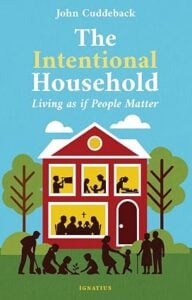
 The Intentional Household: Living as if People Matter
By John Cuddeback.
Ignatius Press, 2026.
Paperback, 167 pages, $17.95.
Reviewed by Xavier Serrani.
It is incredibly difficult today to build a household that values its human members more than its possessions. John Cuddeback’s The Intentional Household: Living as if People Matter endeavors to help readers grapple with that very challenge. Over the course of its eight chapters, Cuddeback articulates eight principles whereby he provides his audience with starting points to consider in cultivating their own households.
In the introduction, Cuddeback lays out the problem: we emphasize things over people. We chase economic success at all costs, viewing household work, proper leisure, and relationships as problems at worst or distractions at best. Consequently, our households are a wreck. Cuddeback’s principles pinpoint places where we can rebuild.
Cuddeback is quick to repeat that his eight principles are precisely that. Each one is a “place to begin—not so much something against which to judge our lives, but as a starting point for thinking more clearly about them.” This recognition establishes a sense of goodwill between author and audience. Because of this posture, the book has an invitational tone instead of an argumentative one.
The first and second chapters blend into one point: prioritize and be responsible for building a household. They make it clear that the kind of life we seek to live is something we can choose. It is not something ‘out there’ in the ether or locked behind gates of someone else’s keeping. An intentional household is something we must build for ourselves; no one else is going to prioritize our households for us.
At the end of the second chapter, Cuddeback summarizes what this prioritization of household-making can become: a craft, or an art. There is a “craft-ed-ness” in how one, over the years, learns the best way (not necessarily the most efficient way) to clean the kitchen, manage the laundry, do the shopping, and the like. Indeed, “in any art or craft there is a studied excellence—a combination of right principles and real experience—that empowers a person to act well…in a particular area.”
Cuddeback incorporates many quotations from various thinkers, mostly ancient but also contemporary. He employs them to buttress his principles as being grounded in historical experience but usually does not engage them deeply. I don’t think these quotes, although they did pique my interest as areas for further reading, add much to his narrative, as his points are appealing on their own.
The third chapter discusses work in the household. Cuddeback observes that economic activity today has been largely divorced from household life. We are separated from the fruits of our labor, and we are usually unable to include our households in meaningful work. Cuddeback offers a concrete example from his own life: raising pigs. He and his family raise and slaughter pigs, and he recounts the rich lessons and experiences this has provided them. This example lost me, a suburbanite, but I see his point. Incorporating substantive work into a household, fitting it into one’s own circumstances, is fertile ground for finding meaning.
The fourth chapter deals with the topic of leisure, and it is the strongest section of the book. Cuddeback rightly distinguishes between leisure and amusement. The line is blurry, but the distinction holds. “Leisure in its purest forms requires that we stop the other things we normally do, most notably the work so characteristic of daily life.” Leisure is really a redirection of the will towards different activities. What I found most insightful about Cuddeback’s discussion of work and leisure, specifically in the household, is that the two are complementary goods. Work and leisure are not opposed: it’s all good stuff.
The fifth chapter discusses technology and how it is used in household life. Cuddeback observes that most technology today aims at one good at the expense of all others: efficiency. This aim is not inherently bad, but it does often go unnoticed: “The common approach to technology is freighted with specific value judgments, generally without our noticing it and reckoning with it.” There are other good things besides efficiency. Despite being critical of the rate at which we adopt new technologies, Cuddeback does not propose a luddite existence. He recognizes that many good technologies are so intertwined with our lives that it is foolish to even try to do without them.
Consider choosing between a leaf blower and a rake. Using a leaf blower is just faster. That’s the rub: it is faster. An increased speed, although good, necessarily precludes other good things. I lose time spent outside in pleasant fall weather, I lose some (needed) exercise, and I lose having piles for the kids to jump into. But goodness, isn’t that the whole point of raking leaves? The argument Cuddeback makes isn’t that we should all abandon our leaf blowers and go back to the good old raking days. It is to alert us to the fact that we are often unconsciously allowing other goods to fall by the wayside in favor of efficiency.
Chapter six discusses relationships between spouses. Cuddeback encourages spouses to be engaged in a common project instead of living their own lives but happening to sleep in the same place. He also discusses other topics such as family planning and contraception, but these wander too far from the rest of the book.
Next come the children. Cuddeback observes that between parents and children, the goods flow both ways. “Children need robust and steady parental involvement. And such involvement is also the deep if obscured need of the parents themselves.” When we farm out our parental duties needlessly, both we and our children lose. In the actual raising of children, Cuddeback’s most impactful point is that of authority. “Central to real authority is that a person has a legitimate power to give direction to another person precisely because of a responsibility to care for that person.” Exercising parental authority is so important precisely because it is parental, and thus ultimately done out of love for the child.
The last chapter discusses the importance of relationships across generations. As with technology, there are multiple goods on offer. Youth is good. So is age. “But what if the weakening of the body actually unlocks or fosters the strengthening of goods that otherwise tend to remain only possibilities?” There are aspects of ourselves that are hidden, or perhaps made impossible to cultivate, by youth. As with children and parents, between the middle aged and the elderly, the goods flow both ways. “The physical needs of the aging engage the younger generations by giving them a key opportunity to serve, and this proximity enables the aging to serve the young in various forms of mentoring.”
There is an oddity accompanying Cuddeback’s articulation of these principles: some are followed by an accommodating sentence, as if he is pulling back what he just articulated. It is as if the book is undercutting itself. Yet the book’s thesis is sound and timely presented. A household must be intentionally built by people who take it responsibly and seriously. This argument stands opposed to the idea that other areas of life outside the home are where we should focus, and that the household will just fall into place on its own. We should focus our energies on our households and the people within them first, and the things outside them second. John Cuddeback articulates accessible principles for those seeking to build an intentional household.
Xavier Serrani holds an undergraduate degree in Political Science from The University of Chicago. He writes both fiction and non-fiction from his home in Indiana.
Support the University Bookman
The Bookman is provided free of charge and without ads to all readers. Would you please consider supporting the work of the Bookman with a gift of $5? Contributions of any amount are needed and appreciated!
