The University Bookman
Reviewing Books that Build Culture
Join Kirktober and help support the mission of the University Bookman
Each week the Bookman brings you fresh reviews of the books that build culture, and essays that enliven the Permanent Things. Last year nearly 90,000 visitors engaged with the Bookman’s reviews, all free of charge and with no advertising to disrupt the reading experience. Our writers are touching hearts and minds across the globe with their reviews, bringing wisdom, creativity, and beauty to bear on the most important conversations happening in literature and culture.
Would you consider a gift to help us continue this work?
If just 1 in 4 of our readers contributed $10, we’d dramatically increase our capacity to recruit the brightest young writers and tackle more books and topics, all with a Kirkian angle. We’ve set a goal of raising $20k this month in order to continue our mission. Exceeding this amount will allow us to expand our work even more.
If you love the Bookman, and read us with regularity, we’d greatly appreciate your generous support this month.
With gratitude,
Luke Sheahan, Ph.D., editor
The University Bookman
P.S. As a special thank you to all Bookman supporters this month, we’ll send you a link to an audio recording of Ex Tenebris, one of Kirk’s best ghostly short stories. We think you’ll really enjoy it.
Campaign Progress
Plus ça change, plus c’est la même chose
The Accidental City: Improvising New Orleans, by Lawrence N. Powell. Harvard University Press, 2012. Cloth, 448 pages, $30. The city of New Orleans has long had a firm grip on the imagination of Americans (a grip that existed long before the round-the-clock news...
Mistaken Identities
America’s British Culture by Russell Kirk. Transaction Publishers, 1993. Cloth, 150 pages, $25.The “identity crisis” is a relatively recent development of human psychology. Most people in history were what they were, and they didn’t bother overmuch to wonder what that...
Union and Liberty
May the Road Rise Up to Meet You by Peter Troy. Doubleday, 2012, 400 pp., $27. “How you know whachu stitchin when it don’ look like nothing but a buncha threads ain’ got nothing t’do wit each otha?” asks the ten-year-old slave Mary as she watches her fellow slave and...

Subterranean Truths
Lord of the Hollow Dark by Russell Kirk. St. Martin’s Press, 1979. $10.95. The best stories by a living American in what is commonly called the supernatural are by Russell Kirk; notably in his collection The Princess of All Lands, which, despite differences in...
Searching while Blindfolded
A comment on a silly piece by Russell Jacoby.
American Sound—Twentieth Century
Voices of Stone and Steel: The Music of William Schuman, Vincent Persichetti, and Peter Mennin by Walter Simmons. Scarecrow Press, 2010 Cloth, 438 pages, $70. In his epochal study Voices in the Wilderness (2008), musicologist Walter Simmons charted the careers and...
The Relevance of T. S. Eliot
Eliot and His Age: T. S. Eliot’s Moral Imagination in the Twentieth Century by Russell Kirk. New York: Random House, 1972. [ISI 2008, 460 pages, paper, $18.] Among all the studies that have been made of the works of T. S. Eliot, too many have been concerned with how...
Founders’ Faith: None of the Above
The Religious Beliefs of America’s Founders: Reason, Revelation, Revolution by Gregg L. Frazer. University Press of Kansas, 2012, 296 pp., $35. The religious views of America’s founders have been fiercely contested in the public arena for many years. The principal...
America Is Hard to See
The American Republic: Its Constitution, Tendencies, and Destiny by Orestes A. Brownson [1865]. Reprinted by Augustus M. Kelley, Publishers: Clifton, New Jersey, 1972.[ISI 2002] It is always a great intellectual experience to examine the operations of a powerful,...
The Book Gallery
A collection of conversations with Bookman editor Luke C. Sheahan and writers and authors of imagination and erudition. Click on the icon in the upper right corner of the video to see more episodes in this series or check out our YouTube page.


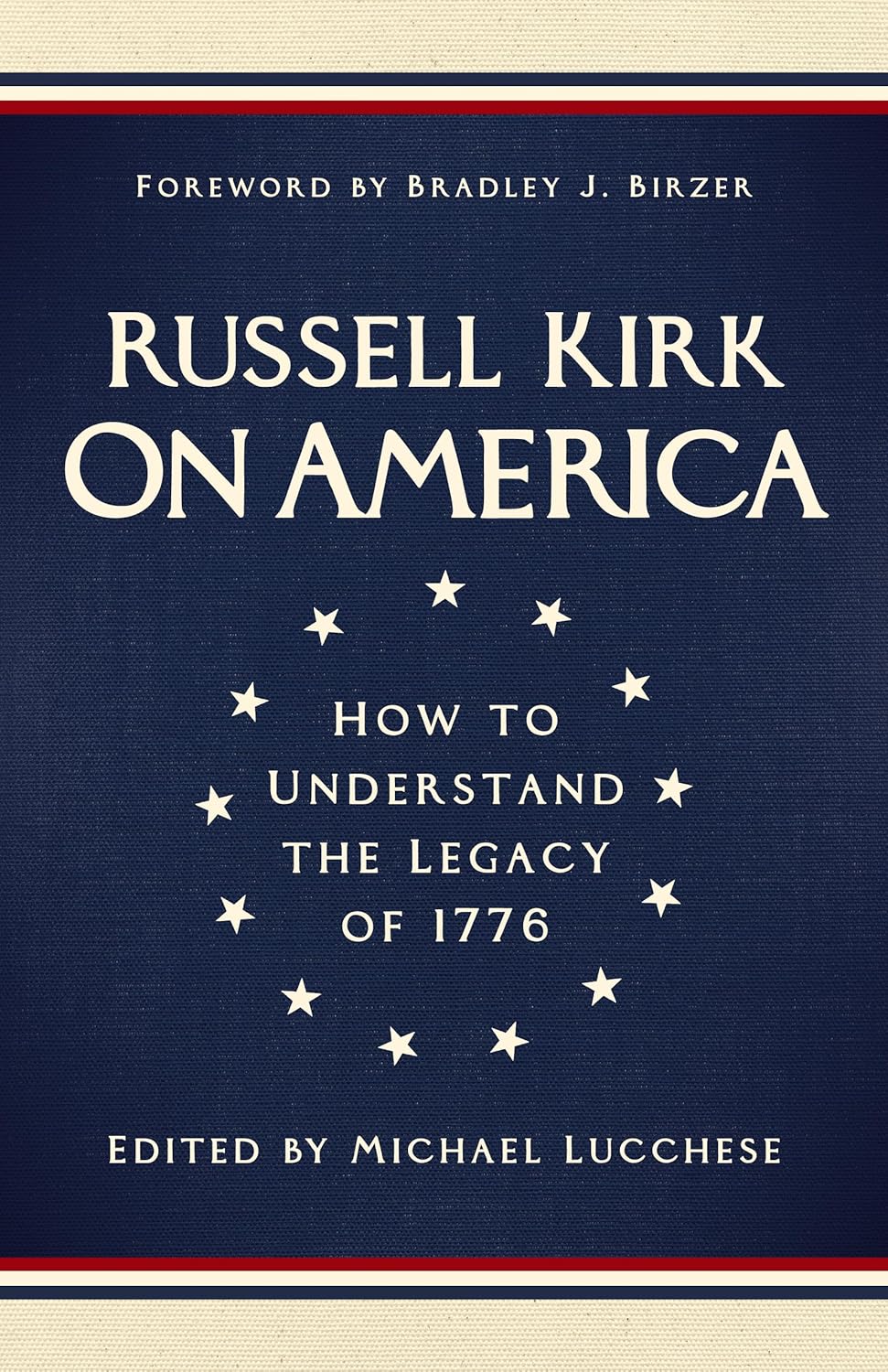
Kirk saw poetry, fiction, tradition, and restraint as essential to understanding America and preserving its character. In his review of "On America," @cjscalia explores Kirk’s vision of the founding, statesmanship, literature, and the enduring ideas that have shaped the republic.
Shop through Creed and Culture Publishing