The University Bookman
Reviewing Books that Build Culture
Join Kirktober and help support the mission of the University Bookman
Each week the Bookman brings you fresh reviews of the books that build culture, and essays that enliven the Permanent Things. Last year nearly 90,000 visitors engaged with the Bookman’s reviews, all free of charge and with no advertising to disrupt the reading experience. Our writers are touching hearts and minds across the globe with their reviews, bringing wisdom, creativity, and beauty to bear on the most important conversations happening in literature and culture.
Would you consider a gift to help us continue this work?
If just 1 in 4 of our readers contributed $10, we’d dramatically increase our capacity to recruit the brightest young writers and tackle more books and topics, all with a Kirkian angle. We’ve set a goal of raising $20k this month in order to continue our mission. Exceeding this amount will allow us to expand our work even more.
If you love the Bookman, and read us with regularity, we’d greatly appreciate your generous support this month.
With gratitude,
Luke Sheahan, Ph.D., editor
The University Bookman
P.S. As a special thank you to all Bookman supporters this month, we’ll send you a link to an audio recording of Ex Tenebris, one of Kirk’s best ghostly short stories. We think you’ll really enjoy it.
Campaign Progress
Longshoreman, Philosopher, Mystery
Eric Hoffer: The Longshoreman Philosopher by Tom Bethell. Hoover Institution Press, 2012. Hardcover, 328 pages, $30.None of Eric Hoffer’s ten slim and streamlined books allowed room for photographic inserts. His biography, Tom Bethell’s Eric Hoffer: The Longshoreman...
A Philosopher of Ordinary Language
Wittgenstein: From Mysticism to Ordinary Language by Russell Nieli. SUNY Press 1987, 261 pp., $32 paper. One of the persistent themes of the Enlightenment was the need to simplify philosophy, to disentangle it from the rhetoric and methods of scholasticism, and to...
chords of wonder
All great systems, ethical or political, attain their ascendency over the minds of men by virtue of their appeal to the imagination; and when they cease to touch the chords of wonder and mystery and hope, their power is lost, and men look elsewhere for some set of...
Christopher Lasch, Conservative?
Hope in a Scattering Time: A Life of Christopher Lasch by Eric Miller. Eerdmans, 2010. Cloth, 394 pages, $32. Christopher Lasch (1932–1994) has often posed a categorical problem for conservatives despite his insightful criticisms of liberalism. On many issues,...
The Household Gods of Freedom
John Randolph of Roanoke: A Study in American Politics by Russell Kirk. Third ed., with select letters & speeches. Indianapolis: Liberty Fund, 1978. [Fourth edition, 1997, cloth $24, paper $14.50.] For Southerners of my antique persuasion, Russell Kirk’s John Randolph...
The Kind of Man Modernity Can Afford
Adventures of an Accidental Sociologist: How to Explain the World Without Becoming a Bore by Peter L. Berger. Prometheus Books, 2011, 264pp, hardcover, $26.A good friend studied sociology at Boston University where Peter Berger spent much of his career. He recalls...
What Is Happening to History?
In 1979 millions of Americans will have spent twenty-three to twenty-six years (about one-third of their expectable lifespan) in schools without having had a single history course. During the late Sixties the majority of colleges and universities abandoned all history...
Freedom Complex
On the Road to Emmaus: The Catholic Dialogue with America and Modernity by Glenn W. Olsen. The Catholic University of America Press, 2012. 303 pp., $70. The Gospel account of the disciples meeting Christ on the road to Emmaus has long been understood as a metaphor for...
Belloc’s Social Thought
Hilaire Belloc, Edwardian Radical by John P. McCarthy. Liberty Press, 1978 [IHS Press, 2009, 373 pages.] To have known someone very intimately and loved him very dearly is not a good qualification for making a useful judgment of his work. Under these limitations, not...
The Book Gallery
A collection of conversations with Bookman editor Luke C. Sheahan and writers and authors of imagination and erudition. Click on the icon in the upper right corner of the video to see more episodes in this series or check out our YouTube page.


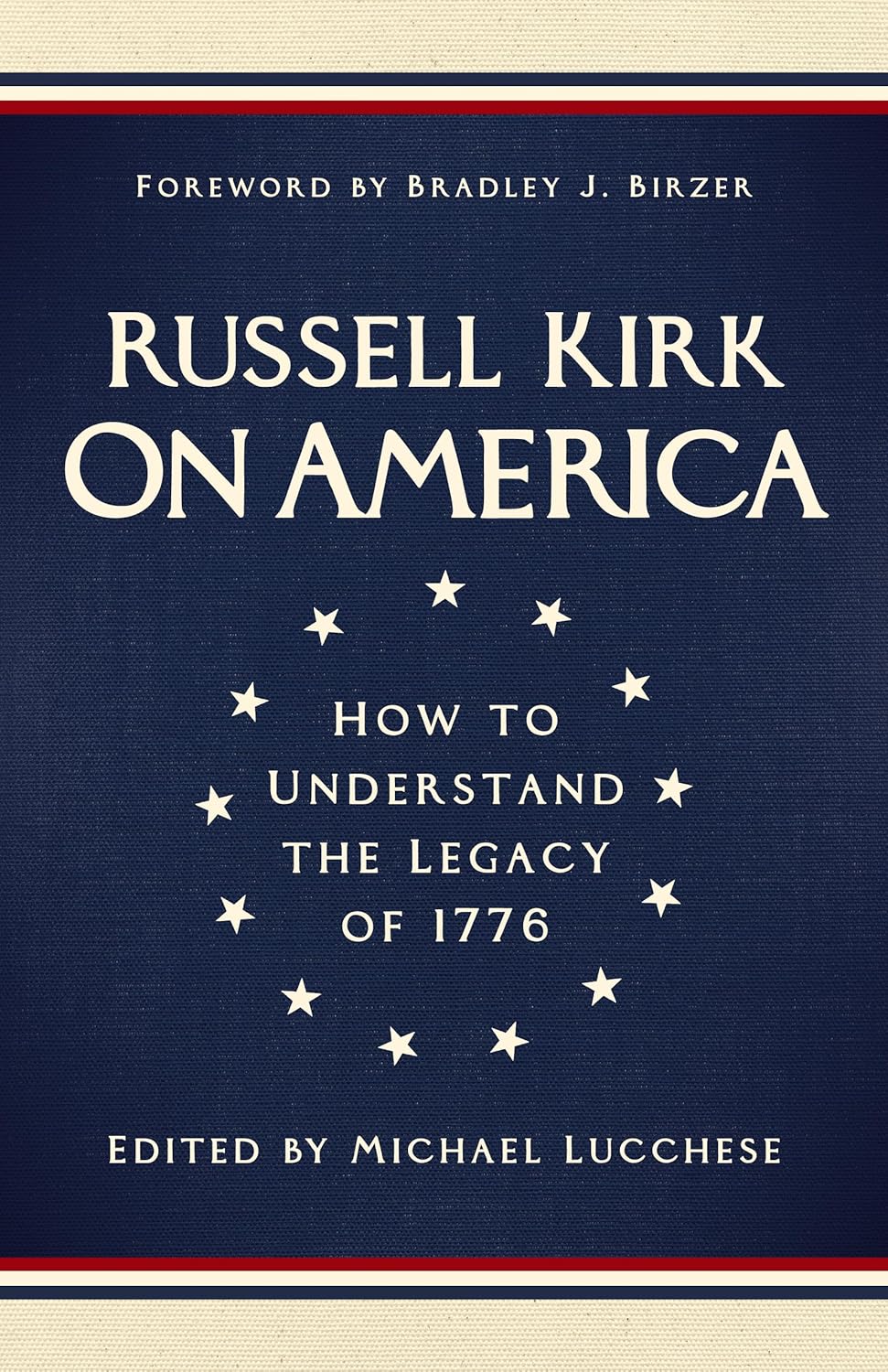
Kirk saw poetry, fiction, tradition, and restraint as essential to understanding America and preserving its character. In his review of "On America," @cjscalia explores Kirk’s vision of the founding, statesmanship, literature, and the enduring ideas that have shaped the republic.
Shop through Creed and Culture Publishing