The University Bookman
Reviewing Books that Build Culture
Join Kirktober and help support the mission of the University Bookman
Each week the Bookman brings you fresh reviews of the books that build culture, and essays that enliven the Permanent Things. Last year nearly 90,000 visitors engaged with the Bookman’s reviews, all free of charge and with no advertising to disrupt the reading experience. Our writers are touching hearts and minds across the globe with their reviews, bringing wisdom, creativity, and beauty to bear on the most important conversations happening in literature and culture.
Would you consider a gift to help us continue this work?
If just 1 in 4 of our readers contributed $10, we’d dramatically increase our capacity to recruit the brightest young writers and tackle more books and topics, all with a Kirkian angle. We’ve set a goal of raising $20k this month in order to continue our mission. Exceeding this amount will allow us to expand our work even more.
If you love the Bookman, and read us with regularity, we’d greatly appreciate your generous support this month.
With gratitude,
Luke Sheahan, Ph.D., editor
The University Bookman
P.S. As a special thank you to all Bookman supporters this month, we’ll send you a link to an audio recording of Ex Tenebris, one of Kirk’s best ghostly short stories. We think you’ll really enjoy it.
Campaign Progress
Online Support Opportunity
The Kirk Center now has a PayPal account which enables secure donations via credit or debit card. We appreciate any contribution you can make toward our publications and seminars to further the Permanent Things. You can make a gift from this page. Thank you!
The Living Edmund Burke
Getting up in recent months an anthology of conservative writing, The Portable Conservative Reader, I had reason to re-read much of Burke. More than ever before, I was impressed with how relevant Burke’s thoughts—and, indeed, Burke’s actions—remain to our present...
How Dead is Edmund Burke?
Walk beside the Liffey in Dublin, a trifle west of the dome of the Four Courts, and you come to Number 12, Arran Quay. This is a brick building of three stories, which began as a gentleman’s residence, some time since became a shop, and now is a governmental office of...
Burke, Providence, and Archaism
The Political Reason of Edmund Burke. By Francis Canavan, S. J. Duke University Press. 1960. $5.00. Edmund Burke and Ireland. By Thomas H. D. Mahoney. Harvard University Press. 1960. $7.50. The Correspondence of Edmund Burke. Edited by Lucy S. Sutherland. Volume II...
Burke Dispassionately Considered
Carl B. Cone, Burke and the Nature of Politics: The Age of the French Revolution, Lexington (University of Kentucky Press), 1964, 527 pages, $9. The Correspondence of Edmund Burke, Vol. IV (July 1778–June 1782), ed. John A. Woods, Chicago (University of Chicago...
Burke and the Principle of Order
What Matthew Arnold called “an epoch of concentration” seems to be impending over the English-speaking world. The revolutionary impulses and the social enthusiasms which have dominated this era since their great explosion in Russia are now confronted with a...
Edmund Burke and the Constitution
Constitutions are something more than lines written upon parchment. When a written constitution endures—and most written constitutions have not been long for this world—that document has been derived successfully from long-established customs, beliefs, statutes, and...
Edmund Burke and the Future of American Politics
“We are at the beginning of great troubles.”Once upon a time it was the assumption of most of the people in the world that the fundamental constitutions of their society would endure to the end of time; or at least for a very great while; or certainly for the lifetime...
Why Edmund Burke Is Studied
To resist the idyllic imagination and the diabolical imagination, we need to know the moral imagination of Edmund Burke.Cato the Elder told his friends, “I had rather that men should ask, ‘Why is there no monument to Cato?’ than that they should ask, ‘Why is there a...
The Book Gallery
A collection of conversations with Bookman editor Luke C. Sheahan and writers and authors of imagination and erudition. Click on the icon in the upper right corner of the video to see more episodes in this series or check out our YouTube page.


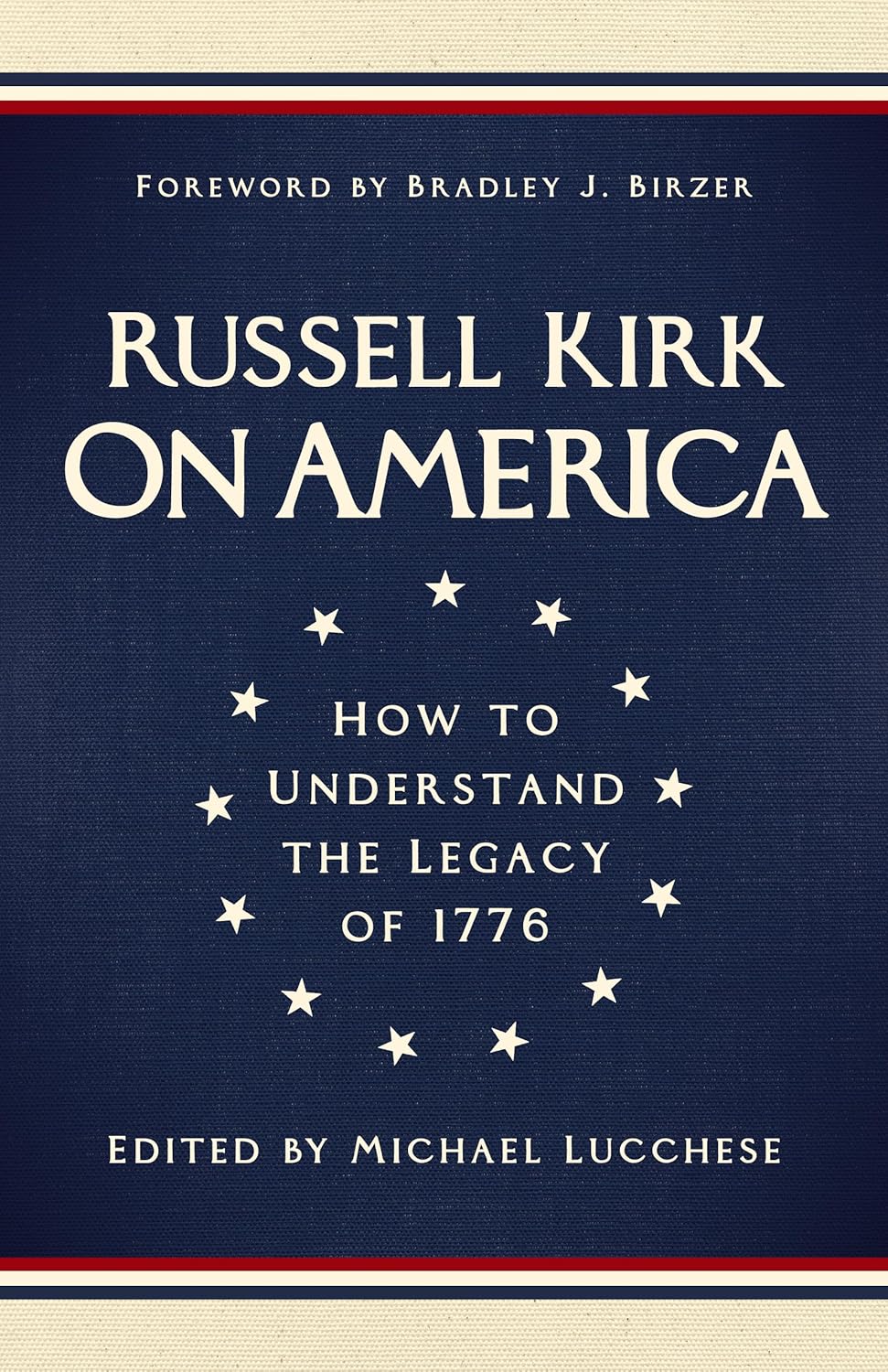
Kirk saw poetry, fiction, tradition, and restraint as essential to understanding America and preserving its character. In his review of "On America," @cjscalia explores Kirk’s vision of the founding, statesmanship, literature, and the enduring ideas that have shaped the republic.
Shop through Creed and Culture Publishing