
Plymouth Library Hosts Capacity Audience for Presentation on Russell Kirk
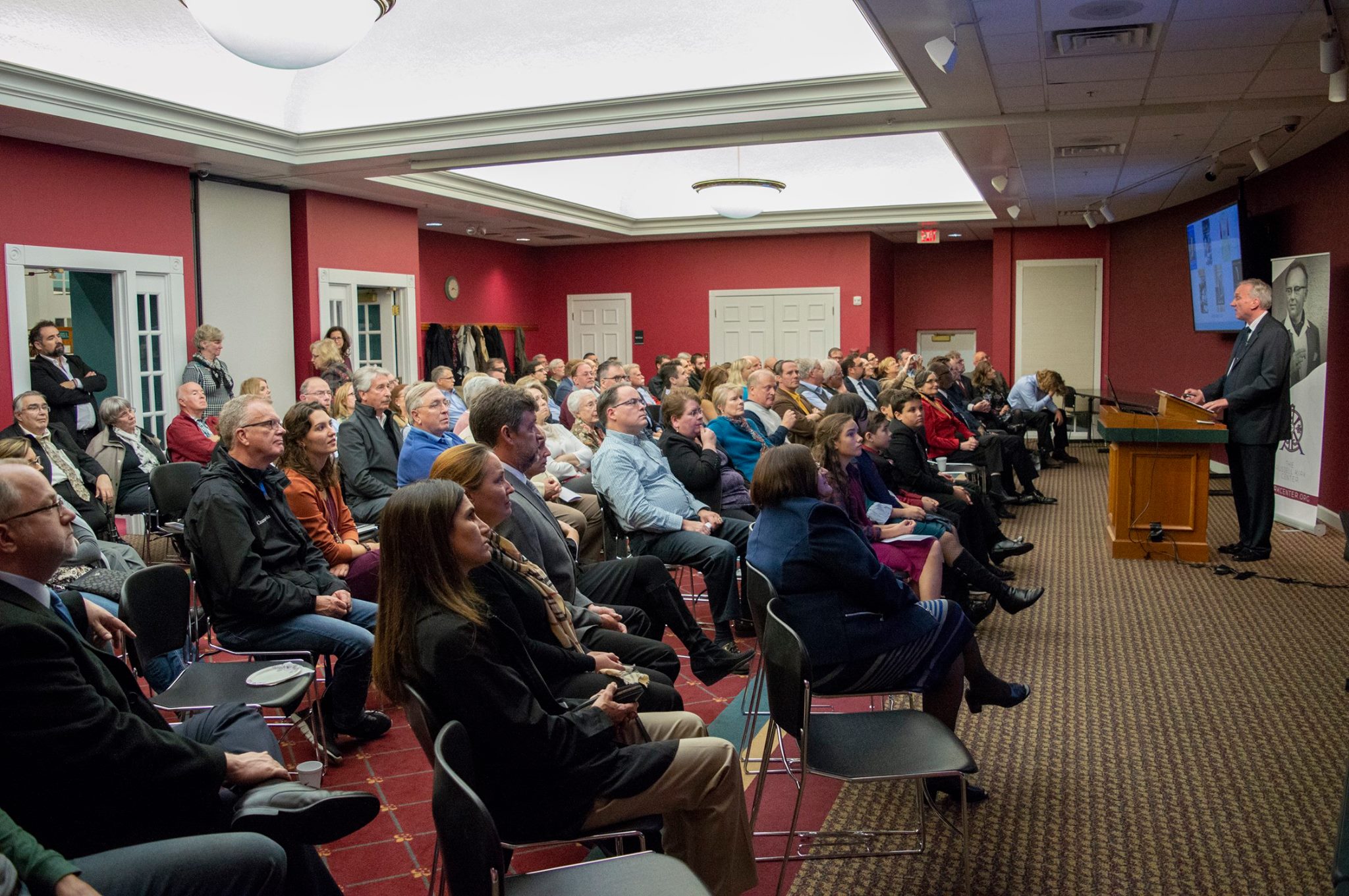
On October 19, 2018–100 years to the date that Russell Kirk was born in Plymouth, Michigan–the Plymouth District Library held an event celebrating his achievements. James Person, editor of Imaginative Conservatism: The Letters of Russell Kirk (2018), spoke on Kirk the man and the writer, accompanied by rarely-seen photos from Kirk’s boyhood in Michigan. In a surprise appearance, representative Jeff Noble presented a tribute in honor of Dr. Kirk from the State of Michigan. Among the several Wilbur Fellow alumni in attendance was attorney Max Goss, who spoke about the Society for Law and Culture, a new program he founded under the auspices of the Kirk Center. A stunning cake resembling a stack of Dr. Kirk’s most popular books made by a local bakery pleased the crowd. Each attendee received a booklet entitled “Russell Kirk: Pillar of Tradition,” a chapter from Ink Trails: Michigan’s Famous and Forgotten Authors, to bring wider attention to the work and thought of “Michigan’s greatest man of letters.”



More From Our Highlights & News
TFAS Woodhouse Public Policy Fellows Explore The Roots of American Order at Piety Hill
From October 15–18, the Russell Kirk Center welcomed twenty Woodhouse Public Policy Fellows from The Fund for American Studies (TFAS) for a thought-provoking seminar on Russell Kirk’s magisterial The Roots of American Order.The seminar was led by Dr. David...
Eugene Volokh Awarded 2026 Richard D. McLellan Prize for Advancing Free Speech and Expression
Our 2026 McLellan Prizes grand prize recipient is Eugene Volokh, influential legal scholar and fellow at the Hoover Institution.
2026 Public Conference “Reclaiming Authentic Conservatism: Russell Kirk and the Roots of American Order”
Can American constitutionalism be reinvigorated? Can a renewal of moral imagination and historical consciousness recover the roots of order—within the soul and within the Republic?
Public Seminar: Knights, Heroes, and Patriots—Howard Pyle and the Shaping of the American Moral Imagination
What vision of life did Pyle offer—and what in that vision might still guide the formation of moral imagination today?