The University Bookman
Reviewing Books that Build Culture
Join Kirktober and help support the mission of the University Bookman
Each week the Bookman brings you fresh reviews of the books that build culture, and essays that enliven the Permanent Things. Last year nearly 90,000 visitors engaged with the Bookman’s reviews, all free of charge and with no advertising to disrupt the reading experience. Our writers are touching hearts and minds across the globe with their reviews, bringing wisdom, creativity, and beauty to bear on the most important conversations happening in literature and culture.
Would you consider a gift to help us continue this work?
If just 1 in 4 of our readers contributed $10, we’d dramatically increase our capacity to recruit the brightest young writers and tackle more books and topics, all with a Kirkian angle. We’ve set a goal of raising $20k this month in order to continue our mission. Exceeding this amount will allow us to expand our work even more.
If you love the Bookman, and read us with regularity, we’d greatly appreciate your generous support this month.
With gratitude,
Luke Sheahan, Ph.D., editor
The University Bookman
P.S. As a special thank you to all Bookman supporters this month, we’ll send you a link to an audio recording of Ex Tenebris, one of Kirk’s best ghostly short stories. We think you’ll really enjoy it.
Campaign Progress
Conservatism in Germany
In Remembrance of Caspar von Schrenck-Notzing (1927–2009)The year 1968 not only marked the culmination of the students’ rebellion, but also the starting point for a conservative counter movement in Germany. Three developments were caused by this event: In 1970 Caspar...
In Praise of Discipline, Common Sense, and a Humane Businessman
Retailer Fred Meijer’s Life Fred Meijer: Stories of His Life by Bill Smith and Larry ten Harmsel, William B. Eerdmans Publishing Company (Grand Rapids, Mich.) 351 pp, $11.00 cloth, 2009 At a time in American history when successful businessmen are widely viewed with...
Magister
Last Rites by John Lukacs, Yale University Press (New Haven, CT) $25.00 hardcover, 2009 It is now twenty years since John Lukacs made his Confessions of an Original Sinner. Has time rolled ’round so soon for his Last Rites? That is the title of his second...
Looking Over Their Shoulder: Orwell and the Intellectuals
Every Intellectual’s Big Brother: George Orwell's Literary Siblings by John Rodden, University of Texas Press (Austin, Texas) 263 pp, $45.00, 2006 The title of Every Intellectual’s Big Brother seems to suggest that there is something malign about the influence...
Mystery Bathed in Light
The Mind that Is Catholic. Philosophical and Political Essays, by James V. Schall, S.J. Catholic University of America Press (Washington, DC) 337 pp, $34.95, 2008 . . . but nobody thought the whole commonwealth fell with the king, or that he alone had ultimate...
Dark Ride: Thomas S. Hibbs on Film Noir and the Quest for Redemption
Arts of Darkness: American Noir and the Quest for Redemption by Thomas S. Hibbs, Spence Publishing $27.95 hardcover, 2008 Early postwar French critics trumped all others in identifying and taking active critical interest in the specifically American genre that they...
Reading Peter Viereck Anew
Shame and Glory of the Intellectuals by Peter Viereck (Reprint Edition with an earlier preface by the author) Transaction Publishers (New Brunswick, N.J.) 330 pp., $34.95 paper, 2007 Unadjusted Man in an Age of Overadjustment by Peter Viereck (Reprint Edition with a...
New World Man
Champlain’s Dream by David Hackett Fischer, New York: Simon and Schuster,848 pp., $40.00, 2009In the 1830s Black Hawk, chief of the Sac and Fox nations, recalled one of his people’s earliest memories. Many years before, his ancestor in the St. Lawrence Valley had a...
Transition
This issue represents the end result of a half-century of conservative reflection on the important books in our cultural conversation. When Russell Kirk founded this journal in 1960, he faced a world beset by liberal ideology, with small place, if any at all, for...
The Book Gallery
A collection of conversations with Bookman editor Luke C. Sheahan and writers and authors of imagination and erudition. Click on the icon in the upper right corner of the video to see more episodes in this series or check out our YouTube page.


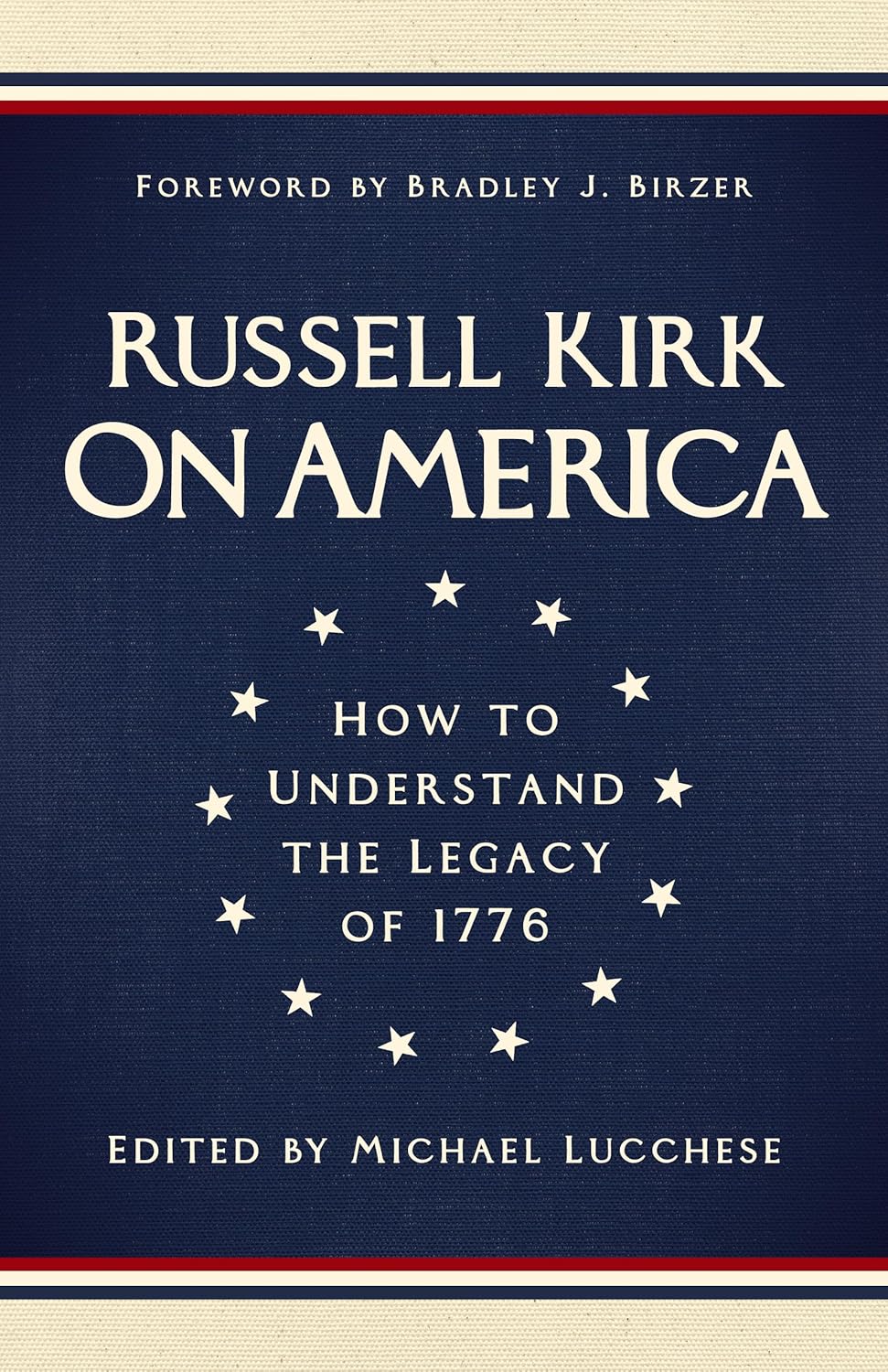
Kirk saw poetry, fiction, tradition, and restraint as essential to understanding America and preserving its character. In his review of "On America," @cjscalia explores Kirk’s vision of the founding, statesmanship, literature, and the enduring ideas that have shaped the republic.
Shop through Creed and Culture Publishing