The University Bookman
Reviewing Books that Build Culture
Join Kirktober and help support the mission of the University Bookman
Each week the Bookman brings you fresh reviews of the books that build culture, and essays that enliven the Permanent Things. Last year nearly 90,000 visitors engaged with the Bookman’s reviews, all free of charge and with no advertising to disrupt the reading experience. Our writers are touching hearts and minds across the globe with their reviews, bringing wisdom, creativity, and beauty to bear on the most important conversations happening in literature and culture.
Would you consider a gift to help us continue this work?
If just 1 in 4 of our readers contributed $10, we’d dramatically increase our capacity to recruit the brightest young writers and tackle more books and topics, all with a Kirkian angle. We’ve set a goal of raising $20k this month in order to continue our mission. Exceeding this amount will allow us to expand our work even more.
If you love the Bookman, and read us with regularity, we’d greatly appreciate your generous support this month.
With gratitude,
Luke Sheahan, Ph.D., editor
The University Bookman
P.S. As a special thank you to all Bookman supporters this month, we’ll send you a link to an audio recording of Ex Tenebris, one of Kirk’s best ghostly short stories. We think you’ll really enjoy it.
Campaign Progress

Remembering Our Unruly Character
“…Frohnen and McAllister are explicit… that Americans must ‘rediscover’ their unruly character, and it becomes clear that their efforts to mine the historical roots of this defiant, ornery nature are grounded in a concern to push back and save the American way of life…”
Why Public Reason Fails
“It is only at a local level that true political deliberation among citizens can take place. Holston’s central message is that, if deliberative democrats are serious about their enterprise, they ought to be working to devolve decision making to the local level as far as possible.”
Friends, Countrymen, Romans
“…America has been many things, but, in a certain sense, it has always been Roman.”

Counting the Costs of the Second Great War
“…April 1945 was especially critical in my combat service in the European conflict in World War II.”
Philosophy and the Meaningful Life
“As Augustine realized, it is not enough to merely know the good, the true and the beautiful. We must lead our lives in conformity with them.”
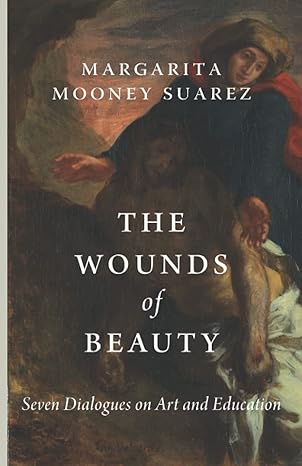
Why Beauty Matters
“…the cultivation of beauty is an education in itself, a discipline that must be practiced in daily life.”
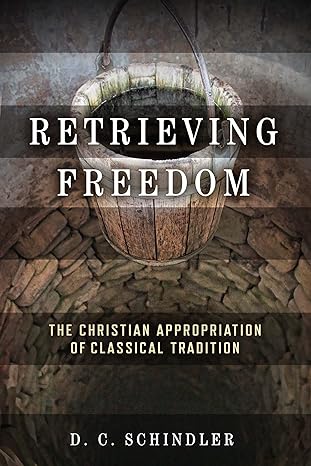
Christian Freedom and the Western Political Tradition
“For Schindler, there is no tradition without freedom, and no freedom without tradition. These ideas are a precious heritage to be guarded with great care, because they are a gift of the wise born before the present and the God who inspired their wisdom.”
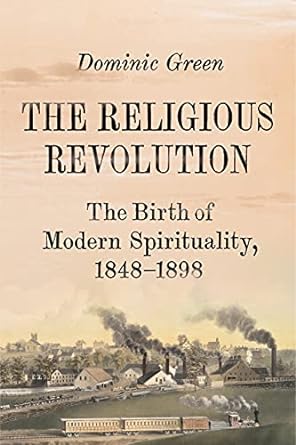
The Spiritualist Origins of Modern Disorder
“…the dominant characteristic of the new spirituality was the inflation, as egregious as it was absurd, of thought, of language, and of self: every man (or woman) a prophet, every man his own priest, every man a genius, each dedicated to what Dominic Green calls ‘the aristocrat within.’”

Politics Awaiting the City of God: James Schall, S.J. on The Nature of Political Philosophy
“This volume collects essays where Schall has reflected on questions of political philosophy that were at the very heart of his vocation as a Catholic teacher.”
The Book Gallery
A collection of conversations with Bookman editor Luke C. Sheahan and writers and authors of imagination and erudition. Click on the icon in the upper right corner of the video to see more episodes in this series or check out our YouTube page.


@ubookman Plus every donor will receive a new audio recording of Kirk's "Ex Tenebris," a great ghostly listen! Help @ubookman reach $20k and continue to review the books that build culture: https://buff.ly/MLnMl4e
Did you hear? This month a generous supporter has offered to MATCH every gift up to $5k for the Kirktober campaign in support of the mission of @ubookman: https://buff.ly/PECA0Az.
Shop through Creed and Culture Publishing